03 / THE TECHNOLOGY
Technology
Worlds with scale.
Systems with a common foundation.
Our ambition: thousands of players across dozens of worlds. The technology behind a civilization that reaches from planetary surfaces into space.
01 / SPACETIMEDB
Multiplayer foundation / scale target
Building toward thousands of players.
A civilization needs more than a small crew. SpacetimeDB provides the shared foundation for player identity and persistent state, alongside accepted world metadata, content references, shared parameters and the celestial clock. Relevance-based networking is part of the path toward larger multiplayer populations.
- Player identity and persistent state, with shared world metadata and time.
- Relevance-based networking designed around nearby activity.
- Thousands of concurrent players is a target, not a verified capacity claim.
02 / ORBITAL MECHANICS
Orbital foundation / system-scale target
Dozens of worlds. A system in motion.
Our system-scale goal is dozens of planets and moons, each with its own orbit, rotation and orientation. The current celestial model organizes planets and their moons into moving families, while body-local coordinates keep terrain attached to its world as the wider system advances.
- Planet-moon families move around a shared center of mass.
- Axial tilt, orbital inclination and independent day lengths.
- A scoped orbital model, not an all-body gravity solver; dozens of bodies remains a scale target.
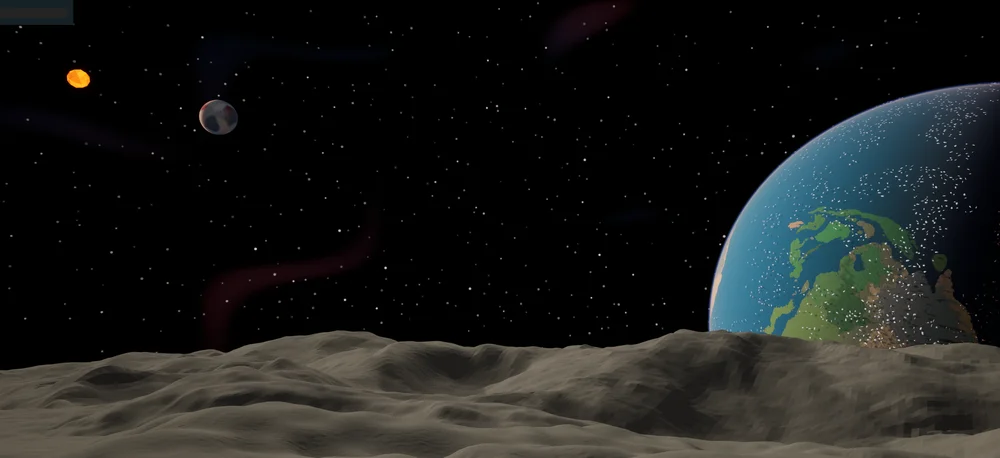
03 / SEAMLESS SPACE-TO-SURFACE FLIGHT
Development flight foundation
From orbit to the ground. One continuous journey.
Seamless space-to-surface flight is central to the experience: approach a world, descend through its atmosphere and reach the landscape below. The development environment connects distant planet representations to adaptive surface terrain, refining the world as it occupies more of the view.
- Orbital and surface detail come from the same published terrain.
- Body-relative frames connect celestial motion to local flight.
- Development traversal exists; broader ship, multiplayer and transition polish continue.
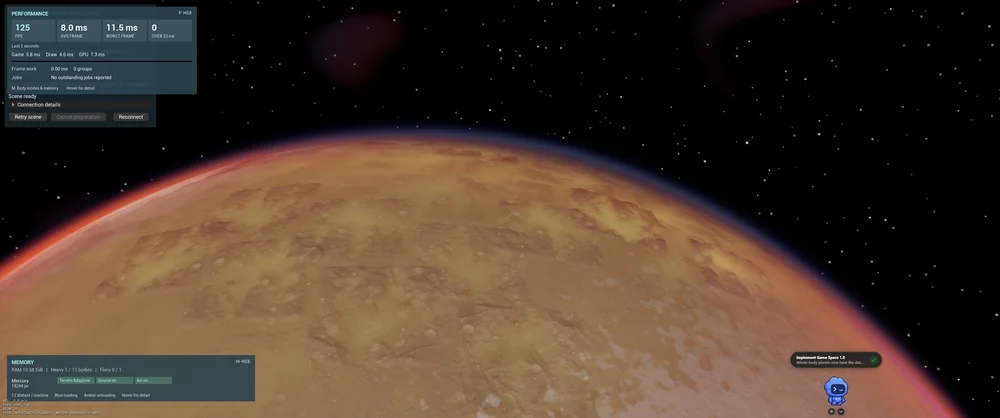
04 / PHYSICS-BASED ATMOSPHERES
Light-transport foundation / ongoing tuning
Light travels through an atmosphere, not a painted backdrop.
The atmosphere renderer models how light is scattered and attenuated through planetary air. Sunlight, viewing direction, atmospheric depth and eclipses help shape what you see, from surface haze to the illuminated edge of a planet. Each world owns its atmospheric presentation.
- Physics-based optical transport with bounded rendering approximations.
- Planetary air, local fog and terrain mist have distinct roles.
- Facet Clouds supply the angular cloud style; this is not a claim of full weather or aerodynamic simulation.
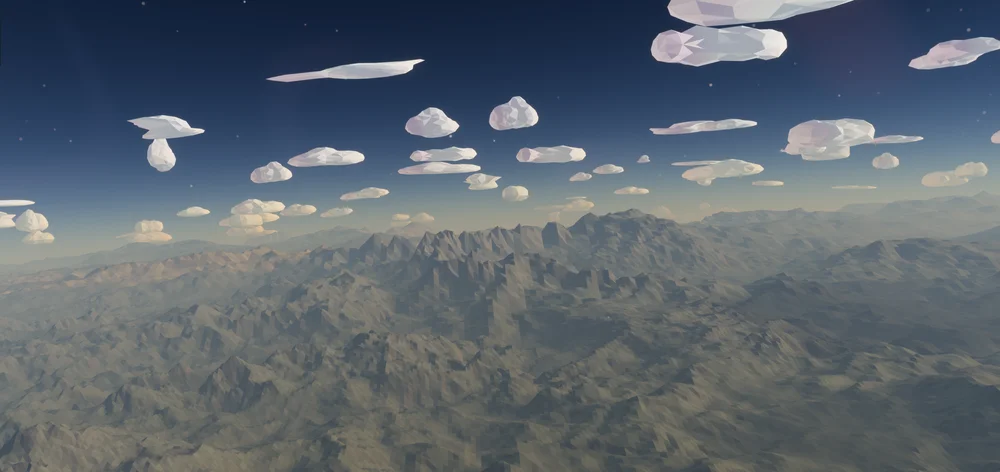
05 / TERRAIN HEIGHTMAPS
Implemented foundation
Mountains with an authored foundation.
Heightmaps encode the elevations that shape our terrain. Planetary System Forge authors terrain source data and publishes immutable, versioned Virtual Recipes. The Terrain Render System reconstructs the landscape from those ingredients and composition rules. The separate, flyable DNA Editor previews the result and supports shared tuning.
- 16-bit height ingredients retain a defined physical elevation scale.
- Versioned recipes connect authoring, visible terrain and collision.
- Compact global coverage and finer regional evaluation serve different viewing scales.
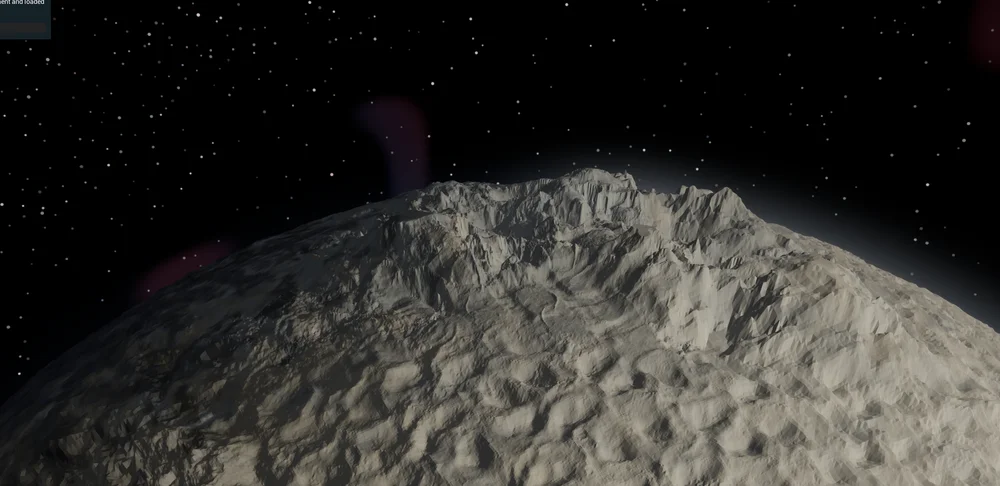
06 / SPACE-BASED LOCATIONS
World and gameplay direction
The space between worlds is a destination, too.
The vision extends beyond planetary surfaces: orbital stations, asteroid fields and player-built infrastructure give people reasons to live and work in space. These locations are intended to connect exploration, engineering and trade across the Eden system.
- Stations and infrastructure as places to build and gather.
- Asteroid resources and routes linking distant communities.
- These are planned destinations, not an announcement of playable station or mining systems.
07 / NANITE
Asset-specific rendering support
Geometry detail where the view needs it.
Nanite is used for compatible meshes within Unreal, supporting the deliberately faceted shapes of Degrees of Freedom. It is an asset-specific capability, not a property of every object: the project also contains integrated flora and geology meshes that do not use Nanite.
- Canonical biome meshes include validated Nanite-enabled assets.
- Nanite eligibility depends on each asset; a pipeline setting alone does not enable it.
- Terrain uses its own renderer. Nanite is not a claim of unlimited detail or a universal performance guarantee.
IN DEVELOPMENT
Based on project documentation reviewed September 30, 2026. These are development foundations and stated goals, not a released feature list. Integration and performance work continue; screenshots are dated development records, not benchmark guarantees.
KEEP EXPLORING
Why Eden built these worlds.
Read the creation story in the words of their custodian.